Rudiq Pay.
Crypto Payment Rails
Institutional-grade payment infrastructure enabling stablecoin transactions, fiat on/off ramp connectivity, and cross-border settlement. Built for banks, payment providers, and enterprises.
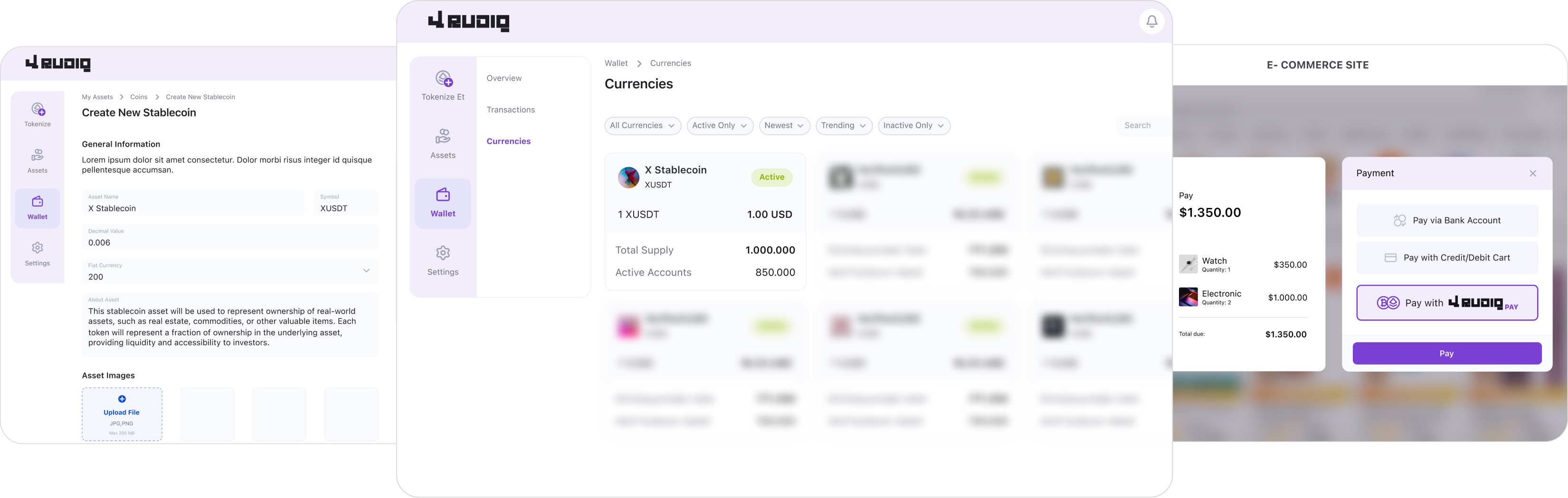
Why Rudiq Pay?
Regulatory clarity is the #1 accelerant of institutional adoption.
Stablecoin Payment Processing
Accept, send, and settle payments in USDC, EURC, and local-currency stablecoins. Real-time settlement with full regulatory compliance.
Fiat On/Off Ramp Integration
Seamless conversion between fiat and crypto. Connected to banking rails for instant fiat-to-stablecoin and stablecoin-to-fiat flows.
Cross-border B2B Payments
Eliminate correspondent banking delays. Direct settlement corridors for institutional cross-border transactions.
E-commerce Crypto Checkout
Enable merchants to accept cryptocurrency payments with automatic settlement to fiat or stablecoin. Simple integration with existing e-commerce platforms.
Recurring Crypto Billing
Subscription and recurring payment support for crypto denominated services. Automated billing cycles with multi-currency support.
Real-time Settlement
T+0 settlement for all payment types. No more waiting for correspondent bank processing or batch settlement windows.
Regulation - Ready.
Regulatory clarity is the #1 accelerant of institutional adoption.
GENIUS Act / SEC / CFTC
United States
Federal stablecoin framework (GENIUS Act, July 2025) establishing reserve requirements and licensing. SEC SAB 122 removed accounting barriers for institutional custody. CFTC approved tokenized collateral for margin (Dec 2025). Clearing regulatory path for institutional adoption.
FDIC and OCC
United States
Our custody and tokenization solution is built to meet the rigorous safety and soundness standards established by the OCC (Office of the Comptroller of the Currency) and FDIC (Federal Deposit Insurance Corporation), aligning with recent joint guidance that ensures tokenized securities receive the same capital treatment and regulatory protections as traditional assets.
MiCA / MiFID II
European Union, since 2024
Comprehensive crypto-asset framework effective since 2024. Stablecoins regulated as e-money tokens, security tokens under MiFID II, and the DLT Pilot Regime enabling market infrastructure innovation.
VARA / Payment Token Services
UAE, July 2024
Virtual Assets Regulatory Authority framework effective since July 2024. ADGM and DIFC-aligned licensing, full reserve backing requirements, AML/CFT and Travel Rule compliance.
FINMA
SWITZERLAND, July 2025
Established DLT securities framework. FINMA-licensed entities can issue and trade tokenized securities with full regulatory clarity under existing Swiss financial law.
KVHS/TUBITAK Framework
TURKIYE
Fully compliant and production-proven through the Digital Turkish Lira CBDC pilot with İş Bank and Ziraat Bank. Aligned with SPK/CMB capital markets regulation.
Frequently Asked Questions
What does “Stripe for Crypto” mean?
Just as Stripe made accepting card payments simple for any business, Rudiq PAY makes accepting and processing cryptocurrency payments simple for any institution. A single integration gives you stablecoin payment processing, fiat conversion, cross-border settlement, and merchant acceptance — without needing to build crypto infrastructure from scratch.
Which stablecoins does Rudiq PAY support?
Rudiq PAY supports major stablecoins including USDC, USDT, and EURC, as well as local-currency stablecoins. The platform is designed to be currency-agnostic, so as new regulated stablecoins enter the market, they can be integrated into the payment rails.
How does cross-border payment work with Rudiq PAY?
Traditional cross-border payments rely on correspondent banking chains that introduce delays, fees, and opacity. Rudiq PAY uses stablecoin rails to settle cross-border transactions in real time, bypassing correspondent banks entirely. Key corridors include Turkey–EU (trade finance and supplier payments), Turkey–UAE (remittances and treasury), CIS–Turkey (cross-border settlement), and EU–UAE (institutional flows).
What is fiat on/off ramp integration?
On-ramp means converting fiat currency (USD, EUR, TRY) into stablecoins; off-ramp means converting stablecoins back to fiat. Rudiq PAY provides both directions seamlessly, so institutions and their clients can move between traditional banking and crypto payment rails without friction.
Can merchants accept crypto payments through Rudiq PAY?
Yes. Rudiq PAY includes e-commerce crypto checkout integration that enables merchants to accept cryptocurrency payments. The merchant can choose to receive settlement in stablecoin or have it automatically converted to fiat. Integration works with existing e-commerce platforms through a simple API.
What is T+0 settlement and why does it matter?
T+0 means settlement happens on the same day — in fact, in real time. Traditional payment systems often settle in T+1 or T+2 (one or two business days after the transaction). With Rudiq PAY, stablecoin-based payments settle instantly, reducing counterparty risk, freeing up working capital, and enabling 24/7 operations beyond traditional banking hours.
Does Rudiq PAY support recurring billing?
Yes. Rudiq PAY supports subscription-based and recurring crypto billing with automated billing cycles and multi-currency support. This is particularly valuable for SaaS platforms, membership services, and institutional service providers who want to offer crypto-denominated payment options to their clients.

Partnering with regulated financial institutions to bring programmable asset infrastructure to market. Built on production experience. Ready for scale.
Get in Touch