Rudiq Safe.
Custody & Smart Ledger Infrastructure
Institutional-grade digital asset safekeeping, ledger management, and stablecoin connectivity. The foundational layer for every digital asset operation your institution will run.
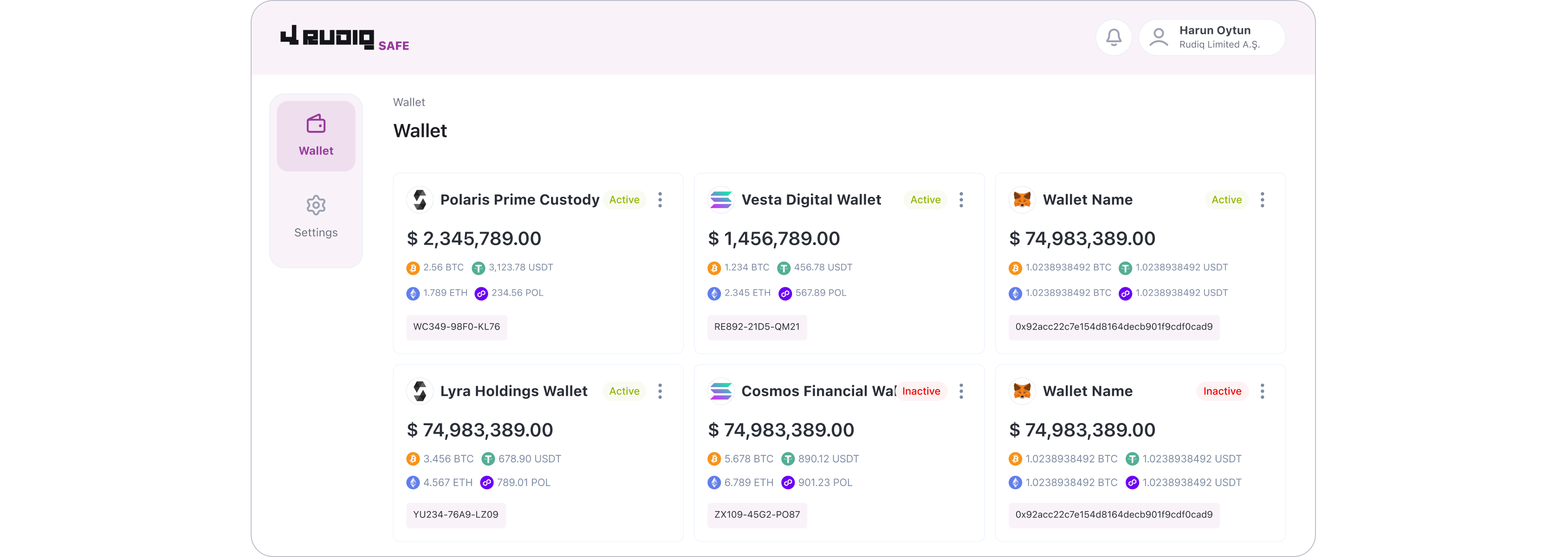
Why Rudiq Safe?
Regulatory clarity is the #1 accelerant of institutional adoption.
Banking-grade Security
- Multi-sig and MPC key management via Fireblocks integration.
- Hot, warm, and cold storage architecture with full private key sovereignty.
- Orchestration rules verified inside Trusted Execution Environments.
- ISAE 3402 Type II, ISO 27001, and FIPS 140-2 Level 3 HSM compliance.
CBDC & Stablecoin Infrastructure
- Production-proven CBDC wallet infrastructure deployed with İş Bankası and Ziraat Bankası under the TÜBİTAK KVHS program.
- Middleware layer connecting stablecoin issuers (USDC, EURC, local-currency tokens) to bank core systems.
- Integrated Notabene connectivity for automated Travel Rule compliance across jurisdictions.
Ledger-based Transaction Management
- Complete audit trail and reporting for every transaction.
- Segregated client accounts.
- Atomic DvP settlement ensures delivery and payment happen simultaneously or not at all.
Flexible Deployment
- Available as on-premise, cloud, or hybrid deployment. Your infrastructure, your rules.
- Full API support with REST and WebSocket connectivity.
Regulation - Ready.
Regulatory clarity is the #1 accelerant of institutional adoption.
GENIUS Act / SEC / CFTC
United States
Federal stablecoin framework (GENIUS Act, July 2025) establishing reserve requirements and licensing. SEC SAB 122 removed accounting barriers for institutional custody. CFTC approved tokenized collateral for margin (Dec 2025). Clearing regulatory path for institutional adoption.
FDIC and OCC
United States
Our custody and tokenization solution is built to meet the rigorous safety and soundness standards established by the OCC (Office of the Comptroller of the Currency) and FDIC (Federal Deposit Insurance Corporation), aligning with recent joint guidance that ensures tokenized securities receive the same capital treatment and regulatory protections as traditional assets.
MiCA / MiFID II
European Union, since 2024
Comprehensive crypto-asset framework effective since 2024. Stablecoins regulated as e-money tokens, security tokens under MiFID II, and the DLT Pilot Regime enabling market infrastructure innovation.
VARA / Payment Token Services
UAE, July 2024
Virtual Assets Regulatory Authority framework effective since July 2024. ADGM and DIFC-aligned licensing, full reserve backing requirements, AML/CFT and Travel Rule compliance.
FINMA
SWITZERLAND, July 2025
Established DLT securities framework. FINMA-licensed entities can issue and trade tokenized securities with full regulatory clarity under existing Swiss financial law.
KVHS/TUBITAK Framework
TURKIYE
Fully compliant and production-proven through the Digital Turkish Lira CBDC pilot with İş Bank and Ziraat Bank. Aligned with SPK/CMB capital markets regulation.
Frequently Asked Questions
What does “custody” mean in the context of digital assets?
Digital asset custody is the institutional-grade safekeeping of cryptographic private keys that control blockchain-based assets. Rudiq SAFE provides this through a combination of hot, warm, and cold storage architectures with multi-sig and MPC key management, ensuring that assets are protected to the same standard banks apply to traditional securities — with full audit trails and segregated client accounts.
How does Rudiq SAFE handle key management and security?
Rudiq SAFE uses Multi-Party Computation (MPC) key management through our Fireblocks integration, combined with HSM (Hardware Security Module) support at FIPS 140-2 Level 3. Orchestration rules are verified inside Trusted Execution Environments. Multiple approval roles, real-time risk monitoring, and a complete audit trail ensure institutional-grade security at every layer.
Can Rudiq SAFE integrate with our existing core banking systems?
Yes. SAFE is built API-first with REST and WebSocket connectivity, designed to plug into existing banking infrastructure. It functions as middleware between stablecoin issuers (USDC, EURC, local-currency tokens) and your core banking systems, eliminating the need to replace existing workflows.
What is the relationship between SAFE and CBDC infrastructure?
Rudiq SAFE's custody and ledger infrastructure was originally built and deployed for the Digital Turkish Lira CBDC pilot with İş Bankası and Ziraat Bankası under the TÜBİTAK KVHS program. That production-proven CBDC wallet infrastructure is now part of the SAFE product, giving institutions a custody layer that has already operated at central-bank-grade requirements.
Is Rudiq SAFE available as on-premise deployment?
Yes. SAFE supports on-premise, cloud, and hybrid deployment models. For institutions with strict data sovereignty or regulatory requirements, the full infrastructure can run within your own environment. Your keys, your infrastructure, your control.
How does SAFE handle Travel Rule compliance?
SAFE includes integrated Notabene connectivity for automated Travel Rule compliance across jurisdictions. Combined with Sumsub integration for KYC/AML verification, this ensures every transaction meets regulatory requirements without manual intervention.
What does Atomic DvP settlement mean?
Delivery versus Payment (DvP) is the principle that asset delivery and payment happen simultaneously. “Atomic” means this is enforced at the blockchain level — either both sides of a transaction complete, or neither does. This eliminates settlement risk, the counterparty risk that exists in traditional T+1 or T+2 settlement cycles.

Partnering with regulated financial institutions to bring programmable asset infrastructure to market. Built on production experience. Ready for scale.
Get in Touch